

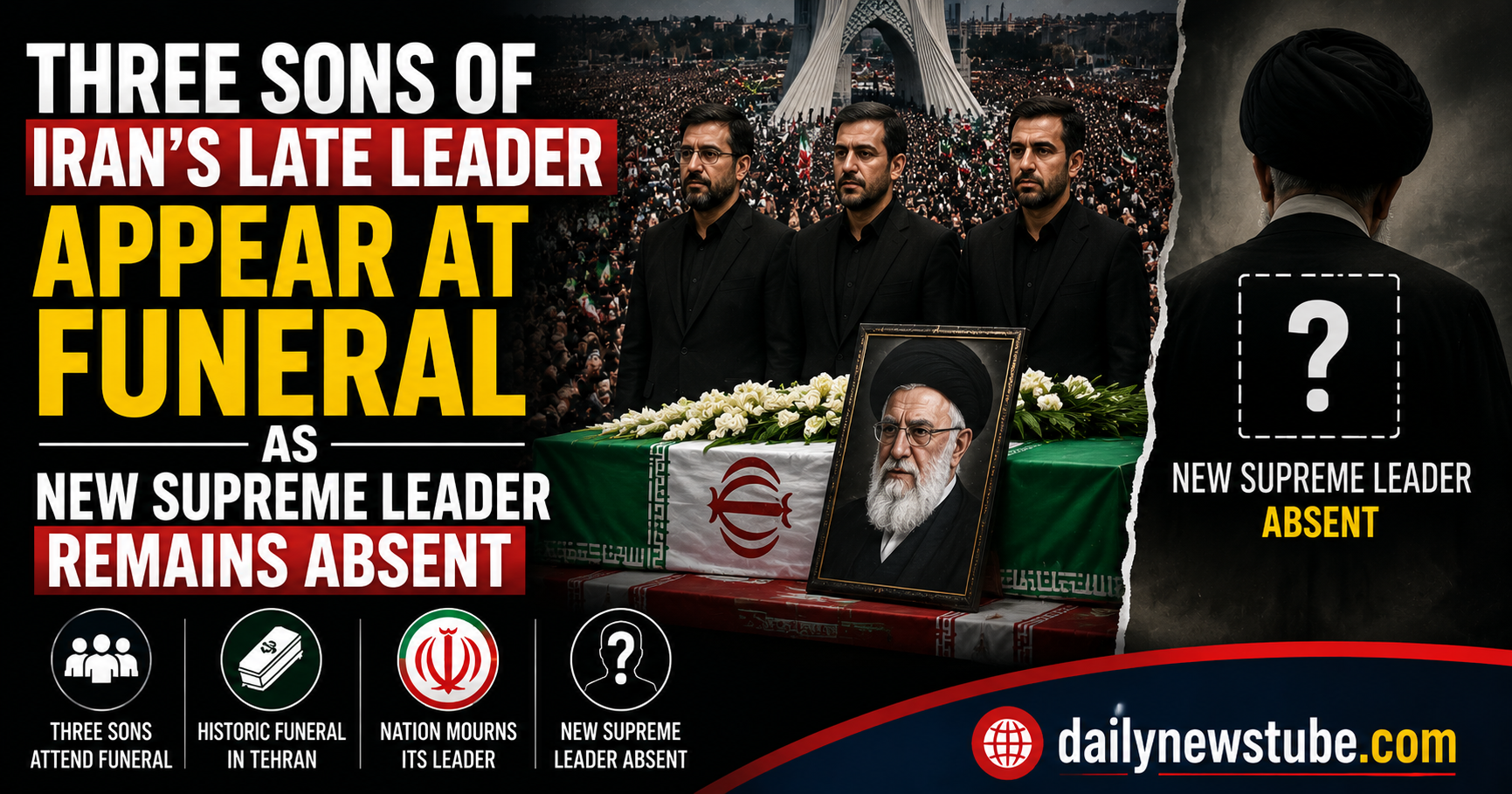
Three Sons of Iran Late Leader Appear at Funeral as New Supreme Leader Remains Absent
Massive State Funeral Continues Amid Questions Over Leadership Transition
Three sons of Iran’s late Supreme Leader Ayatollah Ali Khamenei appeared publicly during a major funeral ceremony in Tehran on Sunday, standing beside their father’s coffin as hundreds of thousands of mourners gathered to pay their final respects. However, one notable absence dominated public attention — Iran’s newly appointed Supreme Leader, Mojtaba Khamenei, did not attend the ceremony.
Iranian state television broadcast images showing Mostafa, Masoud, and Meysam Khamenei participating in funeral prayers at Tehran’s Imam Khomeini Grand Mosalla, one of the country’s largest religious complexes. The appearance marked the first time the three brothers had been seen publicly since the conflict that claimed their father’s life earlier this year.
Mojtaba Khamenei’s Absence Sparks Public Attention
While the presence of three sons demonstrated family unity during the funeral, the absence of Mojtaba Khamenei immediately fueled widespread discussion both inside and outside Iran.
Mojtaba, who succeeded his father as Iran’s Supreme Leader earlier this year, has not made a public appearance since assuming office. Iranian authorities have not officially explained his absence from the funeral ceremony, although several reports suggest heightened security concerns remain a major factor following the assassination of Ali Khamenei.
Security analysts note that Iran continues to treat the country’s highest-ranking leadership as a potential target, making public appearances extremely sensitive.
Funeral Draws Hundreds of Thousands Across Tehran
The funeral ceremony attracted enormous crowds as mourners filled Tehran’s streets, surrounding the Imam Khomeini Grand Mosalla and nearby avenues.
Participants carried Iranian flags, portraits of Ali Khamenei, religious banners, and black mourning flags while joining prayers led by senior clerics. Government officials, military commanders, lawmakers, and religious leaders also attended the ceremony.
Authorities described the gathering as one of the largest public events organized in Iran in recent years, with additional ceremonies planned in several cities before the final burial in Mashhad.
Funeral Reflects Both Religious and Political Significance
The week-long funeral is serving not only as a religious event but also as a demonstration of political continuity following one of the most significant leadership transitions in the Islamic Republic’s history.
Senior members of Iran’s government, the Islamic Revolutionary Guard Corps (IRGC), parliament, and judiciary stood alongside members of the Khamenei family during the ceremony, projecting an image of institutional unity.
Observers believe the government hopes the large public turnout will reinforce confidence in the country’s leadership despite recent military conflict and ongoing diplomatic uncertainty.
Tight Security Measures Surround the Ceremonies
Iranian authorities implemented extensive security measures throughout Tehran to protect participants and senior officials attending the funeral.
Road closures, increased security checkpoints, and heavy police deployments were visible across the capital. Airspace restrictions and enhanced surveillance were also reportedly introduced as a precaution against possible threats during the ceremonies.
The extraordinary security arrangements reflect continued concerns following the conflict that resulted in Ali Khamenei’s death and the subsequent appointment of a new Supreme Leader.
International Delegations Continue Arriving
The funeral has also become an important diplomatic event, attracting representatives from numerous countries across the Middle East, Asia, and beyond.
Foreign delegations have traveled to Tehran to offer condolences and participate in official memorial events alongside Iranian officials. The ceremonies provide an opportunity for diplomatic engagement at a time when Iran remains involved in indirect negotiations with the United States through regional mediators.
Political analysts believe the presence of international representatives demonstrates Iran’s continuing diplomatic relationships despite months of regional instability.
Leadership Transition Remains Under Close Observation
Although Mojtaba Khamenei has already assumed the role of Supreme Leader, his continued absence from public events has attracted considerable international attention.
Analysts suggest Iranian authorities may be prioritizing his personal security while the country remains on high alert. Others believe the government is carefully managing the early stages of the leadership transition before increasing his public visibility.
Regardless of the reason, the absence has become one of the most discussed aspects of the funeral, especially as other senior political and military leaders have appeared publicly throughout the ceremonies.
Nation Continues Mourning as Funeral Procession Moves Forward
The funeral procession is expected to continue over the coming days before concluding with Ali Khamenei’s burial in Mashhad, one of Iran’s holiest cities.
Millions of mourners are expected to participate in various stages of the ceremonies, making it one of the largest state funerals in the country’s modern history.
While the public focus remains on honoring Iran’s longtime leader, attention is gradually shifting toward the country’s future under its new leadership. The combination of national mourning, heightened security, and ongoing diplomatic developments has placed Iran at the center of global attention.
For now, the funeral ceremonies continue to symbolize both remembrance and political continuity, as Iranian authorities seek to project stability during a period of significant transition.

