

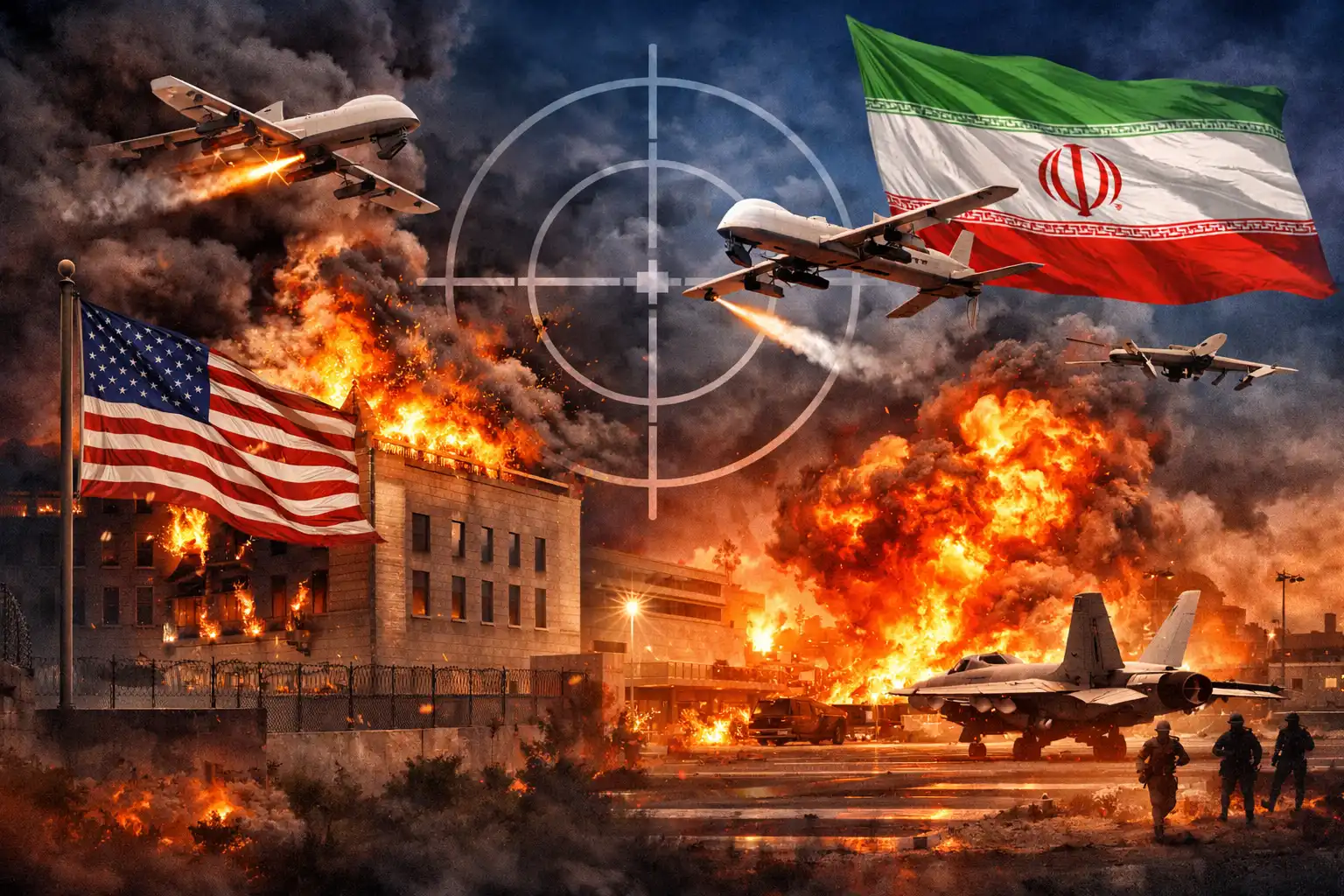
US Embassy in Riyadh Hit by Drones Iran Claims Strike on US Bahrain Base
In a major escalation of hostilities in the Middle East, the US Embassy in Riyadh hit by drones, Iran claims strike on US’s Bahrain base has dominated headlines and heightened fears of a broader conflict. The incidents reflect a wider clash between Tehran and Western-aligned forces triggered by recent military actions. This article unpacks the attacks, regional reactions, and potential implications on diplomacy and security across the Gulf.
Drone Attack on the US Embassy in Riyadh
On March 3, 2026, the US Embassy in Riyadh in Saudi Arabia was struck by two drones in what Saudi authorities and international media describe as part of Iran’s expanding military offensive across the Gulf. According to the Saudi Defense Ministry, the drones caused a fire and minor material damage to the embassy complex located in Riyadh’s Diplomatic Quarter. Fortunately, no casualties were reported, as the compound was unoccupied when the incident occurred.
Eyewitnesses reported hearing explosions and seeing smoke rising over the area, which houses not only the US mission but also other diplomatic facilities. As a result of the strike, the United States Mission issued a “shelter in place” advisory for American citizens in Riyadh, Jeddah, and Dhahran, urging heightened caution and avoidance of embassy premises.
The attack in Riyadh occurred amid a broader wave of Iranian retaliatory strikes after joint military operations by the United States and Israel against targets inside Iran. These actions have led to an unprecedented expansion of the conflict beyond Iran’s borders, engulfing several Gulf states and raising fears of regional instability and war.
Iran Claims Strike on US’s Bahrain Base — Details of the Attack
Alongside the attack in Saudi Arabia, Iranian state media and military sources have publicly stated that Iran’s Islamic Revolutionary Guard Corps (IRGC) targeted the US military’s Fifth Fleet Headquarters in Bahrain. Local reports and government statements from Bahrain confirm that missiles and drones struck the area near Manama, the Bahraini capital, where the naval base and its associated command facilities are located.
The IRGC claimed the assault involved around 20 drones and multiple missiles, asserting that a US command building at the Bahraini base was destroyed. While the exact extent of damage remains difficult to independently verify, footage circulated on social media showed plumes of smoke near the base following the explosion.
Bahrain’s domestic authorities also reported damage to several civilian buildings and infrastructure from debris and intercepted missiles during the barrage. Initial reports suggest drone fragments impacted residential areas in Manama and nearby Muharraq, causing material damage and at least one reported injury.
The Bahraini government condemned the attacks as a flagrant violation of its sovereignty and vowed to work with international partners to enhance security and deterrence.
Regional and Strategic Context of the Strikes
These incidents reflect a broader shift in Iran’s military posture. Since late February 2026, Iran has launched a series of missile and drone attacks targeting US assets and allied facilities across multiple Gulf states, including Kuwait, Qatar, and the United Arab Emirates.
This offensive has been described by Tehran as retaliation for a coordinated US–Israeli military operation against key Iranian sites, including leadership compounds and defense infrastructure. Iranian authorities argue that their actions constitute legitimate self-defense against what they characterize as unlawful aggression.
The conflict has triggered ripple effects across the region: airspace closures, cancellations of commercial flights, emergency travel advisories for civilians, and public warnings from US diplomatic missions in several Middle Eastern capitals urging citizens to stay vigilant.
Saudi Arabia, which hosts the attacked US Embassy in Riyadh, has condemned Iran’s strikes as an infringement on regional peace and stability. Meanwhile, other Gulf Cooperation Council (GCC) members have expressed solidarity with affected nations and pledged stepped-up defense measures.
Implications and Future Prospects
The US Embassy in Riyadh hit by drones, Iran claims strike on US’s Bahrain base episodes underscore how rapidly diplomatic and military tensions can escalate in geopolitically sensitive regions. Such attacks on diplomatic missions and military installations carry profound implications for international relations, particularly between Tehran and Washington, as well as with Riyadh and other Gulf capitals.
Beyond immediate security concerns, these developments have raised anxiety among global markets, especially in the energy sector, given the strategic importance of the Gulf region. Oil prices have shown volatility as fears of broader conflict and potential supply disruptions increase.
Finally, the attacks may influence diplomatic engagements and peace initiatives. Governments worldwide are closely watching whether Iran or Western forces will pursue further escalation or seek a pathway to de-escalation through negotiation and international mediation.

