

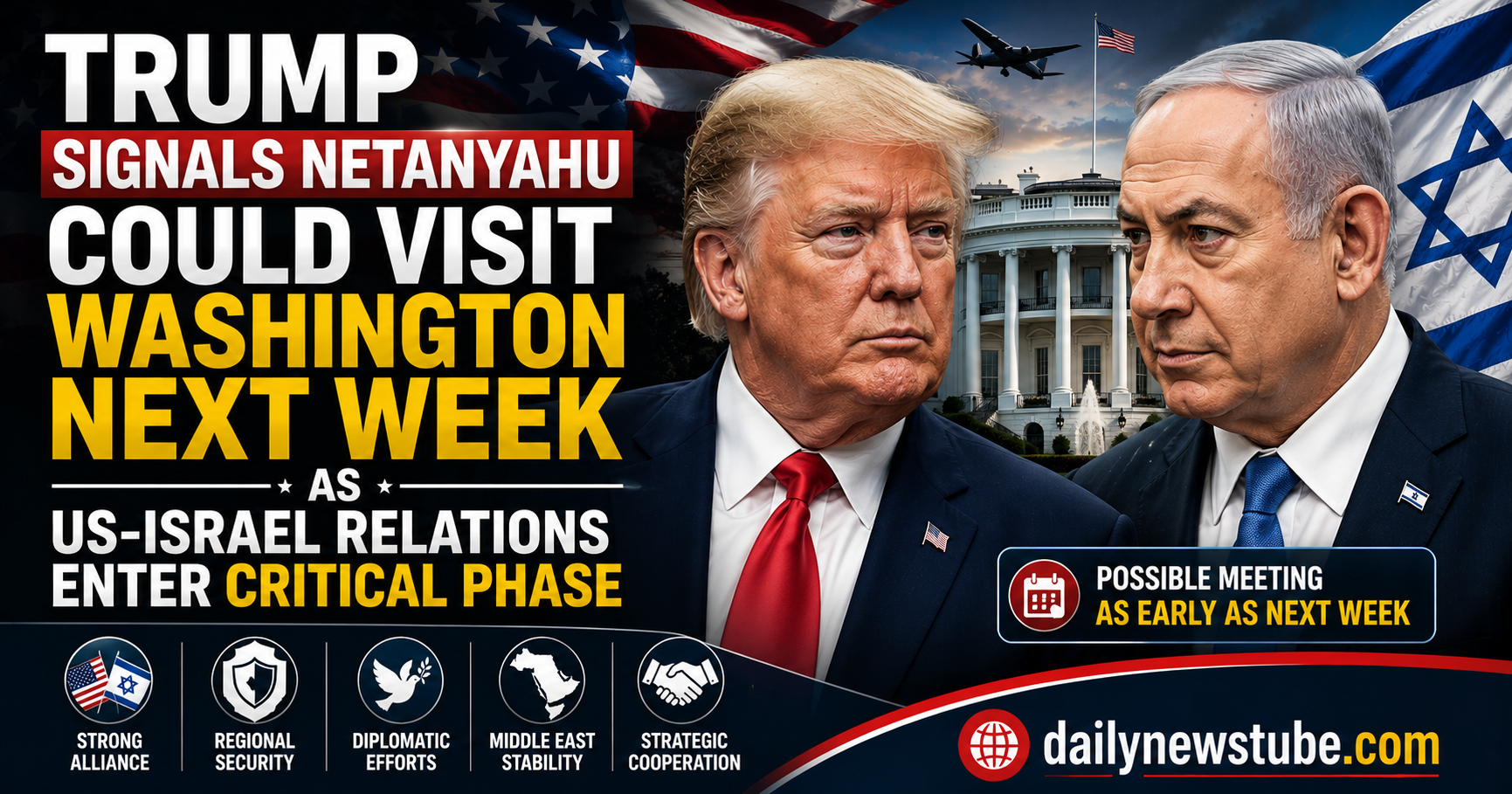
Trump Signals Netanyahu Could Visit Washington Next Week as US-Israel Relations Enter Critical Phase
Possible White House Meeting Comes Amid Regional Diplomacy and Security Challenges
United States President Donald Trump has indicated that Israeli Prime Minister Benjamin Netanyahu could visit Washington as early as next week, a meeting that would come at a pivotal moment for US-Israel relations and ongoing diplomatic efforts across the Middle East.
Speaking in an interview, Trump revealed that Netanyahu had requested a meeting at the White House, adding that discussions could take place shortly after his return from the upcoming NATO summit. If confirmed, the visit would mark Netanyahu’s first trip to Washington since the recent conflict involving Iran and would be his seventh visit since Trump returned to office.
The announcement comes as both leaders face mounting regional challenges, including ceasefire efforts, security concerns, and negotiations involving Iran.
Meeting Expected to Focus on Regional Security
Although the White House has not released an official agenda, analysts expect regional security to dominate the discussions.
The United States continues working with regional partners to preserve the fragile understanding reached with Iran through indirect negotiations, while Israel remains focused on threats from Iran-backed groups and broader security concerns across the region.
Officials also expect Gaza, Lebanon, maritime security, and future US-Israel military cooperation to feature prominently during the meeting if it proceeds as planned.
Diplomatic observers say the outcome of the talks could shape Washington’s Middle East strategy for the coming months.
Trump and Netanyahu Seek to Rebuild Momentum
Relations between Trump and Netanyahu remain strategically important despite recent policy differences.
In recent weeks, both leaders have publicly emphasized the strength of the US-Israel alliance while acknowledging that difficult conversations continue regarding the best approach toward Iran and regional stability.
Reports suggest the two leaders recently spoke by telephone before agreeing to arrange an in-person meeting in Washington.
Political analysts believe both governments see value in presenting a united front while continuing discussions over security coordination and diplomatic initiatives.
Iran Diplomacy Adds New Dimension
The possible White House meeting comes as Washington continues indirect diplomatic engagement with Iran through regional mediators.
Recent technical talks hosted in Doha produced cautious optimism after mediators reported positive progress on several issues related to maritime security and confidence-building measures.
Israel has closely monitored these negotiations, expressing concerns about any agreement that could affect its long-term security interests.
The expected discussions between Trump and Netanyahu are therefore likely to include extensive consultations regarding the future direction of American diplomacy with Tehran and its potential impact on Israel’s security strategy.
Gaza and Lebanon Remain High Priorities
Beyond Iran, both leaders are expected to discuss ongoing developments in Gaza and along Israel’s northern border.
Humanitarian conditions in Gaza continue attracting international attention, while periodic security incidents involving Hezbollah have kept tensions elevated despite diplomatic efforts to reduce violence.
Washington has consistently encouraged measures that improve regional stability while maintaining Israel’s security, whereas Israeli officials continue emphasizing the need to respond firmly to emerging threats.
These issues are expected to play a central role during any bilateral meeting.
Netanyahu Faces Political Pressure at Home
The proposed visit also carries significant domestic political importance for Netanyahu.
As Israel prepares for future political contests, maintaining strong relations with Washington remains an important element of his leadership strategy.
A successful White House meeting could reinforce Israel’s close partnership with the United States while demonstrating continued American support during a period of regional uncertainty.
At the same time, Netanyahu must balance diplomatic engagement with domestic expectations regarding national security and negotiations involving neighboring countries.
US Foreign Policy in the Spotlight
For President Trump, the meeting represents another opportunity to demonstrate his administration’s active role in Middle East diplomacy.
Since returning to office, Trump has sought to balance strong support for Israel with broader diplomatic initiatives aimed at reducing regional tensions.
His administration has encouraged indirect dialogue with Iran while continuing close security cooperation with Israel and other regional allies.
Officials believe maintaining both diplomatic engagement and strategic partnerships will be essential to preventing another large-scale regional confrontation.
Global Attention on the Upcoming Meeting
Governments, investors, and regional observers are watching closely as reports of the possible meeting continue to emerge.
Any decisions affecting Iran, maritime security, Gaza, or Lebanon could influence energy markets, diplomatic relations, and security planning throughout the Middle East.
Although no official date has yet been announced, Trump’s remarks suggest preparations are underway for another high-level meeting between the two longtime allies.
Outlook Remains Closely Watched
If the visit takes place, it is expected to become one of the most closely followed diplomatic events of the month.
The discussions would provide both leaders with an opportunity to coordinate policy on some of the region’s most pressing issues while reaffirming the strategic relationship between the United States and Israel.
Despite ongoing differences over aspects of regional diplomacy, both governments continue emphasizing cooperation on shared security objectives.
For now, attention remains focused on whether Netanyahu’s proposed visit will be formally confirmed and what concrete outcomes may emerge from a meeting that could influence the future direction of Middle East diplomacy during an especially sensitive period.

